Welcome to the second edition of Putting the Fun in FUNdraising!
Every Friday, we pull back the curtain on real-world non-profit dilemmas to give you the raw, actionable strategies you need to lead without burning out. Today, we are diving into a classic governance trap: The Reluctant Expansion.
If you are reading this on the go, you can watch my full 3-minute video masterclass breaking down the crisis and the exact solution right here: Watch here
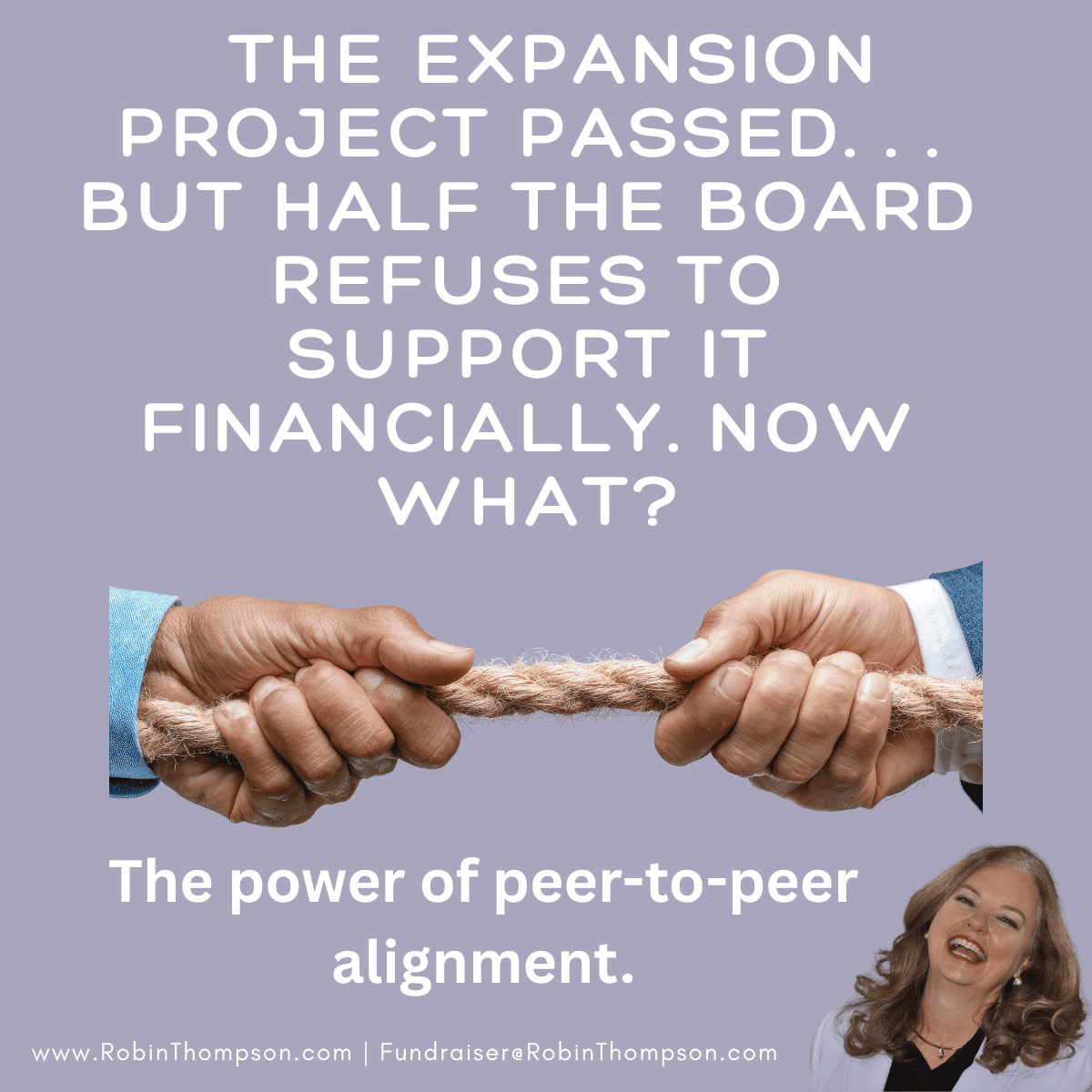
The Dilemma: An Approved Plan with Zero Support
It’s one of the most frustrating traps in the non-profit sector. Under pressure, a divided board reluctantly passes a major new project. BUT THERE’S A CATCH!
The moment the meeting ends, reality sets in. The majority of the board is privately against it, feeling it’s simply too much, too soon. In fact, half of the board members explicitly state that they will not support the project financially, nor will they talk to the community to champion it.
You’re left holding an approved plan with a leadership team that completely refuses to carry the weight.
How do you salvage this? How do you get a divided board to actually back a project they voted for?
The Reveal: The Absolute Power of Peer-to-Peer Influence
When faced with a fractured room like this, the natural instinct for an Executive Director is to push harder from the top down. We send more data, write longer emails, and try to force compliance. But that just breeds deeper resentment.
Instead, we took a relationship-first approach. We looked at the room and leveraged the power of peer-to-peer influence.
We asked one of their most long-standing, universally respected board members to step up. He personally called each of the skeptical trustees for a casual, one-on-one conversation. He shared exactly why he believed in the expansion and why he suggested they back it.
Because it came from a trusted peer, the defensive walls came down. Every single board member ultimately contributed financially and agreed to support the project.
Robin’s Coaching Takeaway
Peer-to-peer influence among board members is infinitely more powerful than an Executive Director pushing an agenda. When you need to align a fractured board, find your champion within the room and let them lead the conversation.
Your Action Step This Week: The next time your board passes a motion but lacks enthusiasm, don’t try to be the lone salesman. Identify your key board ally, equip them with the talking points, and let peer dynamics do the heavy lifting for you. It protects your boundaries, saves your sanity, and keeps leadership fun!
Let’s Connect!
I want to hear from you: Have you ever had a board vote pass, only to have the room completely freeze up when it was time to execute? How did you handle it? Drop your thoughts in the comments below!
If you know an Executive Director or Board Chair facing a fractured room right now, send this their way. See you next Friday!
Source material: This article was synthesized from my original presentation using AI technology. I have personally reviewed, edited, and refined the text to ensure it accurately reflects my insights.