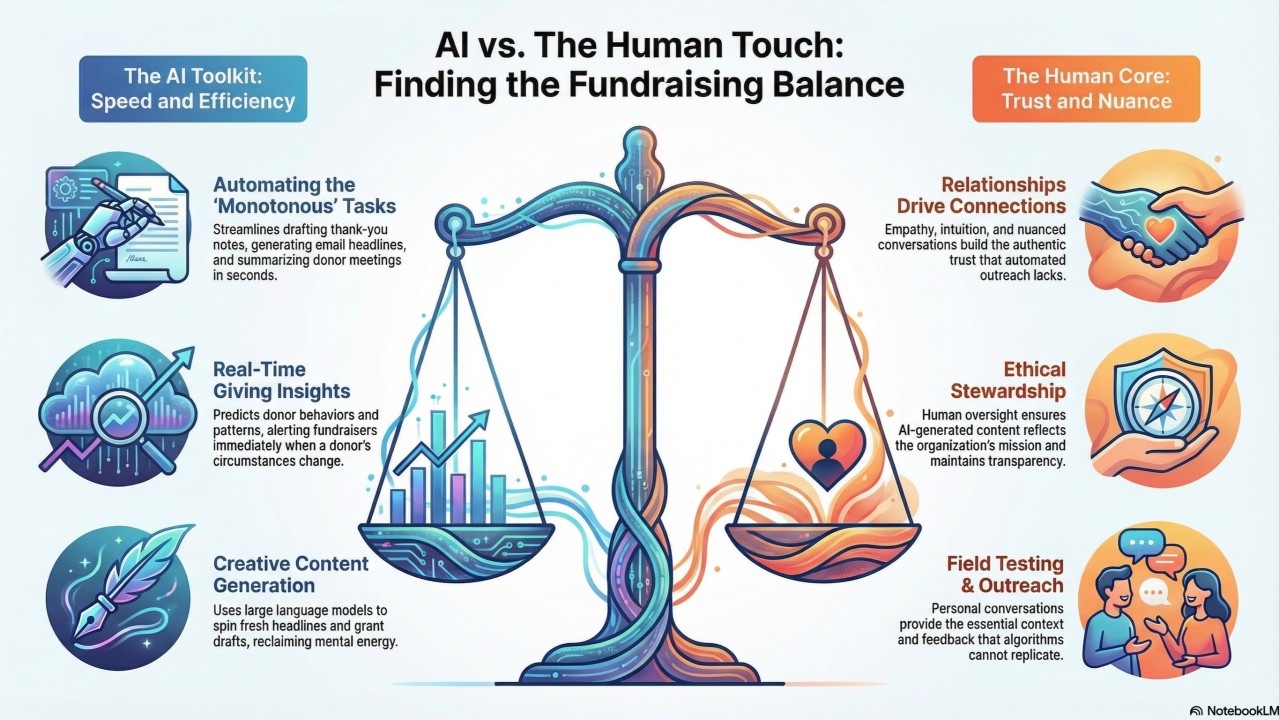
As artificial intelligence tools become more deeply woven into the fabric of nonprofit operations, particularly in fundraising, it’s easy to imagine a future where algorithms and models handle every aspect of donor relations. Yet a close examination reveals that while AI brings immense speed and convenience to many tasks, the irreplaceable power of genuine human connection remains at the heart of successful fundraising. Here’s why developing real relationships will always outpace automated outreach.
For a more in-depth discussion, listen to audio podcast interview here or copy this link into your browser: https://share.descript.com/view/sQ4P9BeyniM
The Evolution from Early Prospect Research to Modern AI
Fundraisings embrace of technology is nothing new. The use of tools like Blackbaud’s ResearchPoint or DonorSearch introduced a new era of data-driven giving insights years ago. Early prospect research required manually matching records and making sense of static data—often with imperfect or outdated results. Modern AI now refines this process by learning from donor behaviors, predicting giving patterns, and alerting fundraisers the moment a donor’s circumstances change. Tasks that once demanded hours of research and analysis are completed in seconds.
Still, even with these smarter systems, field testing—actually talking to donors and their networks—remains essential. The nuance and context provided by conversations simply cannot be automated. AI offers a rapidly expanding toolkit, but it’s a tool set meant to be wielded by people, not a replacement for them.
Where AI Shines in Fundraising Workflows
The advantages of AI in reducing tedious tasks are clear. AI streamlines repetitive duties like drafting thank you notes or acknowledgment letters and helps generate subject lines for emails that grab attention. Large language models such as ChatGPT or Gemini are especially effective for producing fresh language or spinning out multiple creative headlines, freeing up fundraisers’ mental energy for more strategic work.
Specialized AI assistants now aid with grant writing, building presentation slides, summarizing meetings, and even generating personalized music for donors. Meanwhile, tools like Gamma automate deck creation, and platforms such as Canva incorporate AI to enhance visual storytelling. For time-strapped professionals, these innovations help reclaim hours that might otherwise be lost to monotonous tasks.
Why Relationships Are the Enduring Core
Despite these efficiency gains, I repeatedly emphasize that “relationships are still what drives the connection” in fundraising. Even the most well-phrased email or data-rich donor profile can’t substitute for the trust and authenticity built through human interaction. AI may be able to analyze giving trends or personalize communications, but it lacks the empathy, intuition, and nuanced understanding that come from real conversations and genuine outreach.
Personal connections with donors cultivate long-term support, feedback, and loyalty—benefits that aren’t easily replicated by any algorithm. Job security for fundraisers lies precisely in this human capacity for forming bonds, listening, responding, and inspiring action. The best fundraisers will use AI to handle the background work, reserving their energy for these meaningful moments.
Navigating the Ethical Landscape
As nonprofit professionals incorporate AI into their everyday routines, new ethical considerations inevitably arise. I caution against relying too heavily on AI-generated text without scrutiny—granting agencies could theoretically flag applications as inauthentic, and there’s always the risk of inadvertently reproducing someone else’s work. The key is to use AI suggestions as a starting point, then thoughtfully adapt and personalize the content until it truly reflects your mission and voice.
Equally important is the matter of trust. Using AI tools to create fabricated testimonials or events, even as placeholders, risks eroding the organization’s integrity if discovered. Responsible adoption means transparency, ethical editing, and a genuine commitment to truthfulness and value in every donor interaction.
Source material:
This article and audio were synthesized from my original video presentation using AI technology. I have personally reviewed, edited, and refined the text to ensure it accurately reflects my insights.