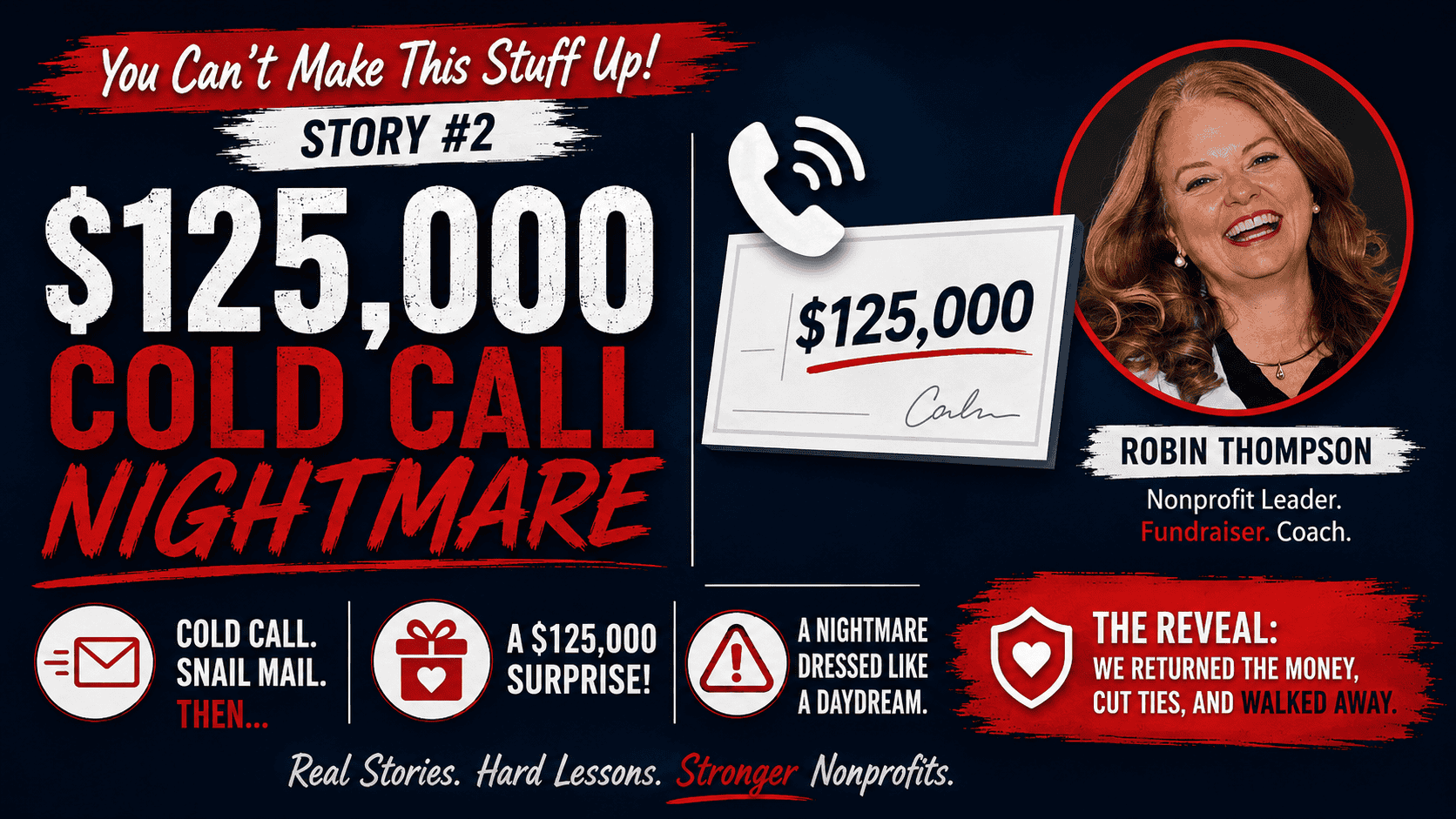
Welcome back to our series, You Can’t Make This Stuff Up! (True Stories & Hard Lessons in Nonprofits) for scenario #2.
As fundraising leaders, we all prefer warm introductions: meeting people while volunteering, getting introduced through a mutual friend, or striking up a conversation in line at the post office. But every now and then, when all else fails, you have to start “dialing for dollars.”
Cold outreach in fundraising rarely produces instant major gifts. But one afternoon, a single cold call led to a $125,000 check and one of the wildest donor management lessons of my career.
The $125,000 Cold Call
I had devised a strategic way to identify potential local supporters: cross-referencing county assessor data for recent property purchases and segmenting invitations by neighborhood based on where our board members lived. We’d send a warm snail-mail invite: “Our board members enjoy welcoming new people to the community. They would like to invite you over to get to know you and share a bit about our mission.”
During my research, I found a woman who had recently moved into the area. She had previously founded a children’s foundation, making her an ideal match for our youth-focused nonprofit.
When I cold called her, she actually answered her cell phone. She asked me to send over some mailers. As we all know, much of what we send ends up straight in the “round file” over the trash can.
Three months later, my phone rang.
It was her. She was in town and wanted to drop off a check in person. Imagine my surprise when she walked into our office and handed us a $125,000 check as her first-time gift! We were thrilled.
“A Nightmare Dressed Like a Daydream”
As Taylor Swift famously sang, she quickly proved to be “a nightmare, dressed like a daydream.”
Almost immediately, the relationship went completely off the rails over things entirely outside of our control:
- She became furious over how long the post office took to deliver her check to us.
- She began sending bizarre, demanding text messages to our CEO’s personal cell phone in the middle of the night.
- She began issuing rigid ultimatums demanding complete control over how the funds were spent, ignoring our mission boundaries.
As exciting as it was to receive a $125,000 gift, it was even more liberating to do what few nonprofits have the nerve to do: we returned the money, cut ties, and walked away.
The Framework: Knowing When (and How) to Return a Gift
Returning a major gift is scary, but keeping a toxic donor can destroy your culture, burn out your staff, and derail your mission. Here is the 3-step framework I use to help organizations evaluate whether to keep a high-maintenance gift:
1. Distinguish “High-Touch” from “High-Toxicity”
Major donors often require high-touch stewardship, special updates, and personal attention. That’s normal. Toxicity, however, looks like personal harassment, boundary violations (like late-night texts to executive staff), or demands that force your team to break ethical or operational guidelines.
2. Protect Your Team’s “Mindshare”
Calculate the hidden cost of the gift. If your CEO, development directors, and program staff are spending 80% of their emotional energy navigating one donor’s erratic demands, that $125,000 is actually costing you money in lost productivity, team burnout, and missed opportunities elsewhere.
3. Execute a Professional “Return & Release”
If a gift must be returned, keep it brief, professional, and firm. Do not engage in a back-and-forth debate.
“We are so grateful for your initial desire to support our work. However, based on the parameters required, it is clear that our operational structure and your expectations are not aligned. To ensure your intent is fully honored elsewhere, we are returning your funds so you can invest in an organization better suited to your specific criteria.”
The Takeaway
Not all money is good money. Your organization’s integrity, your staff’s sanity, and your core mission are worth far more than a check with strings attached. When you establish firm boundaries, you free up space for donors who truly align with your vision and respect your team.
Have you ever had to return a gift or walk away from a toxic funding situation? How did your leadership handle it? Let’s discuss! Email me.
Source material: This article was synthesized from my original presentation, book, and other writings using AI technology. I have personally reviewed, edited, and refined the text to ensure it accurately reflects my insights.
About the Author: Robin Thompson is a seasoned nonprofit coach, consultant, and author. She brings decades of hands-on fundraising experience and a passion for empowering others with the latest technology while never losing sight of the relationships that make every gift possible.